
NASA’s Parker Solar Probe, the first spacecraft to visit the sun’s atmosphere

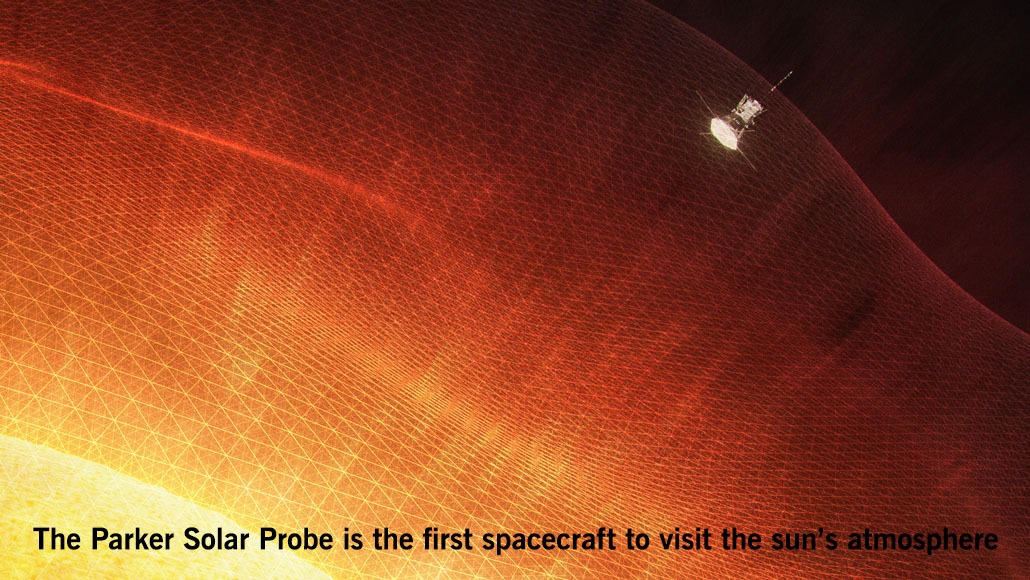
First time in history, the spacecraft has contacted the sun. During the recent flight, NASA’s Parker Solar Probe entered the solar system.
“We have reached the end,” said Nicola Fox, director of NASA’s Heliophysics Science Division in Washington, D.C., at a press conference on December 14 at the American Geophysical Union. “Mankind has touched the sun.”
Parker left the centre of the planets and landed in the sun-drenched area on April 28, 2021, during his encounter with the sun. While we were there, an investigation took the initial estimates of where the border, called the Alfvén critical surface, lies. Nearly 13 million miles [13 million km] above the sun, physicists reported on the conference, which was held online and in New Orleans, and in the Physical Review review material on December 14th.
Recommended read: India’s Contribution In Nasa’s Most Powerful Telescope.
Astronomer Justin Kasper of the University of Michigan told a press conference that they knew that Alfvén’s critical condition must be in place but they didn’t know where it located.”
Obtaining this important layer was one of Parker’s main goals when it was launched in 2018 (SN: 7/5/18). The sensitive area of Alfvén is important because it indicates where the plasma packets may separate from the sun and become part of the solar system, a fast-flowing stream of charged particles that constantly emanate from the sun (SN: 8/18/17). Solar wind and other, extremely atmospheric conditions can cause damage to Earth’s satellites and even life (SN: 2/26/21). Scientists want to pinpoint the exact origin of the atmosphere so that they can better understand how it affects the earth.
Alfvén’s precarious position may hold the key to one of the great mysteries of the sun: why the corona of the sun, its clever outer space, is much hotter than the surface of the sun (SN: 8/20/17). With more heat sources, temperatures drop as you go farther. But the Sun’s surface is only a few thousand degrees, while the sun’s corona is over a million degrees Celsius.
In 1942, naturalist Hannes Alfvén proposed a solution to a dilemma: A magnetic field might transport energy from the sun’s rays and heat a corona. It took until 2009 to see directly such waves, in the lower corona, but they did not carry enough energy to describe all the heat (SN: 3/19/09). Solar physicists suspect that the rise of waves and colliding with Alfven’s sensitive area can play a major role in heating the corona. But until now, scientists have not known where the frontier began.
With the boundary point, “we will now be able to testify directly to how coronal heating occurs,” Kasper said.
As Parker crossed the invisible border, his tools recorded a dramatic increase in the local magnetic field and a decrease in charged densities. In a solar system, waves of flaming particles emanate from the sun. But below the precipice of Alfvén, some of those waves crash on the horizon.
Recommended read: Vaishno Devi stampede last midnight: 12 Dead
Surprisingly, Parker’s estimates showed that Alfvén’s sensitive area was shrivelled. “That was one of the great questions,” said solar scientist Craig DeForest of the Southwest Research Institute in Boulder, Colo.
Decades ago, scientists thought that the earth was a smooth globe that revolved around the sun like a glacier. Recently, some thought it would be so rumoured that it could not be seen when the spacecraft crashed.
None of these photos is already valid. The surface was smooth enough that the crossing time was visible, Kasper said. But as the spacecraft approached the sun in April, it sped off and crossed the border three times. The first dip lasted about five hours, and the last one was half an hour.
That structure could have a profound effect on anything from how the solar eclipse leaves the sun to the way the solar wind interacts with itself away from the sun, DeForest said. “This is very exciting. Terra incognita. ”
Parker is still orbiting the sun and plans to make a few nearby trails in the next few years, eventually reaching 6 million miles from the solar system. Repeatedly it should bring Parker to the solar corona, solar scientist Nour Raouafi of the Johns Hopkins Applied Physics Laboratory in Laurel, Md, told at a news conference.
The spacecraft may have made another trip past the critical juncture of Alfvén in August and will have another opportunity in January.
Recommended read: Income Tax Department On Search Of UP Samajwadi Party MLA Pushpraj Jain
Raouafi said that the expectation was that they will continue to cross this border as they fly closer to the sun. But the boundary may not always be in the same place. As the sun’s activity changes, Alfvén’s critical level is expected to rise and fall as if the corona is breathing in and out, he said.
That is something that scientists hope to see for the first time.
Source- ScienceNews
